200+ Riddles About Time With Answers for Kids & Adults
👋 Introduction
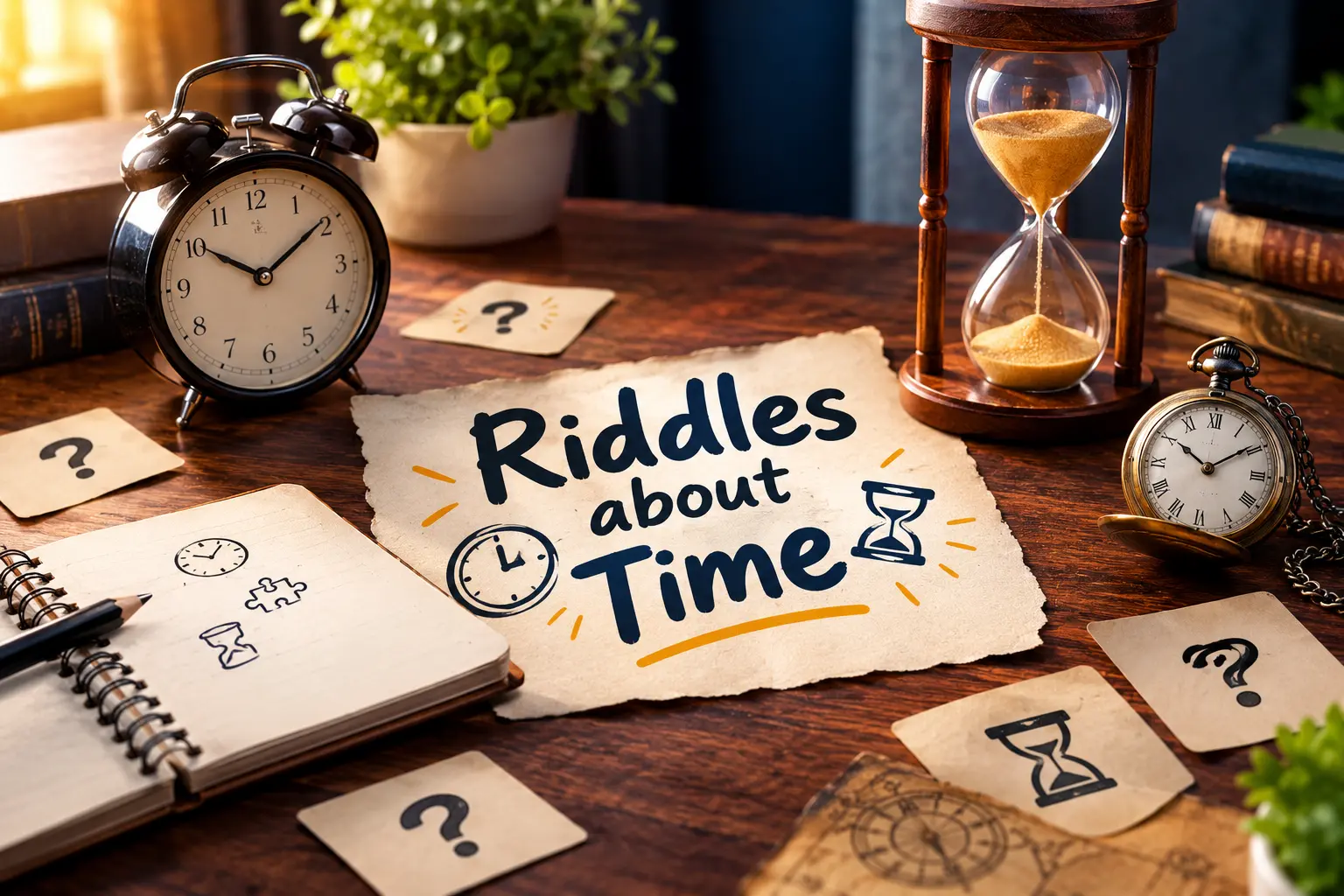
Time is something we experience every day, but describing it in a clever way can be surprisingly difficult. ⏰🧠 These best riddles about time with answers are a fun way to test your thinking, challenge your friends, and enjoy some clever wordplay.
In this collection, you will find easy riddles about time, time riddles for kids, funny and classic riddles, clock riddles, tricky brain teasers, hard time riddles, and riddles for adults and couples. 🕰️✨ We also include interesting riddles about hours, minutes, seconds, and even time travel.
Each riddle includes its answer and a simple explanation, so you can understand the idea behind it. Try solving each one before looking at the answer! Get ready to think, guess, laugh, and discover how many different ways time can be turned into a clever riddle. ⏳🎯
Table of Contents
⏰ Best Riddles About Time with Answers
⏰ Time is something we all experience every day, but how well can you describe it without simply saying “clock”? These best riddles about time with answers are a fun way to test your thinking, challenge your friends, and discover clever wordplay. 🧠✨ From easy time riddles for kids to tricky brain teasers for adults, this collection has something for everyone. Whether you love solving puzzles, enjoy testing your logic, or simply want a fun way to pass a few minutes, these riddles will keep your mind ticking. ⏳ Get ready to think, guess, laugh, and have fun as you work your way through these clever riddles about time! 🕰️🎯
Answer: A Clock ⏰
💡 Explanation:
A clock has a face and hands, but they are not like a person's face or hands. Its hands move around the clock face to show the passing of time.
Answer: Time ⏳
💡 Explanation:
Time is constantly moving forward. You can choose how to use it, but you cannot rewind and recover a moment that has already passed.
Answer: Twelve (12)
💡 Explanation:
On a standard 12-hour clock, 12 comes after 11. After 12, the hour cycle starts over with 1.
Answer: A Clock Hand ⏰
💡 Explanation:
Clock hands constantly move around the clock face. They "run" through seconds and minutes, yet the clock itself remains in the same place.
Answer: 12 o’clock
💡 Explanation:
The number 12 appears at both 12 AM and 12 PM. One marks midnight, while the other marks noon.
Answer: Your Age
💡 Explanation:
Your age increases by one every year. Birthday candles often represent the number of years you have lived.
Answer: A Clock
💡 Explanation:
A stopped clock shows the correct time twice a day on a 12-hour clock. It can also be "broken" or stopped without being alive in the first place.
Answer: Time
💡 Explanation:
Time contains countless seconds, minutes, and hours. We cannot physically see or hold time, but everyone experiences it.
Answer: Today
💡 Explanation:
Every day is called today while we are living through it. Once it ends, it becomes yesterday.
Answer: An Alarm Clock
💡 Explanation:
An alarm clock does not sleep, and its alarm can wake people up with a loud ringing or beeping sound.
Answer: Time
💡 Explanation:
Time constantly moves from the past toward the future. Everyone experiences its passage, but time itself cannot be seen or physically touched.
Answer: Time
💡 Explanation:
Every moment you spend means there is less time remaining in your day or life. Unlike money, time cannot be saved indefinitely or purchased back once it has passed.
🌟 Easy Riddles About Time
If you enjoy simple puzzles that are fun to solve, these easy riddles about time are a perfect place to start. ⏰🧠 Each riddle has a simple clue, a clear answer, and a short explanation to help you understand the trick. Let’s see how many you can solve before checking the answers! 🎯✨
Answer: Yesterday 🌅
💡 Explanation:
Once a day has finished, it becomes yesterday. You can remember what happened, but you cannot go back and live that day again.
Answer: Tomorrow 🌄
💡 Explanation:
Tomorrow is the day after today. When tomorrow arrives, it becomes today.
Answer: The Weekend 🏖️
💡 Explanation:
The weekend usually means Saturday and Sunday. For many people, it is a break from the regular working or school week.
Answer: Noon / 12 PM ☀️
💡 Explanation:
Noon is the middle of the daytime, commonly recognized as 12 PM.
Answer: Midnight 🌙
💡 Explanation:
Midnight occurs at the transition between one calendar day and the next, traditionally marked as 12 AM.
Answer: February 29 🗓️
💡 Explanation:
During a leap year, February gets an extra day, making it February 29 instead of ending at February 28.
Answer: Waiting Time ⏳
💡 Explanation:
When we focus closely on waiting, time can feel slow. When we are distracted, the same amount of time may feel much faster.
Answer: A School Day 🏫
💡 Explanation:
A school day has a set starting and finishing time and includes lessons and activities.
Answer: A Memory 📸
💡 Explanation:
A short event can become a strong memory that stays with someone for a very long time.
Answer: Bedtime 🛏️
💡 Explanation:
Bedtime is the planned time when someone gets ready to sleep, especially at the end of the day.
🧒 Time Riddles for Kids
Ready for some fun time riddles for kids? 🧠⏰ These easy and playful puzzles help children think about days, dates, seasons, birthdays, and everyday moments. Try solving each one before looking at the answer! 🎯✨
Answer: Morning 🌅
💡 Explanation:
Morning is the first part of the day, usually beginning when the sun rises and ending around midday.
Answer: Night 🌙⭐
💡 Explanation:
Night comes after evening and is usually the time when people sleep.
Answer: May 🌸
💡 Explanation:
May has four letters and comes between April and June.
Answer: A School Bell 🔔🏫
💡 Explanation:
A school bell signals important times during the school day, such as the start and end of classes.
Answer: A Birthday 🎂🎁
💡 Explanation:
A birthday happens once each year and celebrates the day a person was born.
Answer: Rain 🌧️
💡 Explanation:
Rain can last for different amounts of time, from a short shower to several hours.
Answer: The Four Seasons 🌸☀️🍂❄️
💡 Explanation:
The year is commonly divided into spring, summer, autumn, and winter, with each season bringing different weather and changes.
Answer: Evening 🌆
💡 Explanation:
Evening is the part of the day between afternoon and night.
Answer: The School Week 📚
💡 Explanation:
For many children, the school week runs from Monday through Friday.
Answer: A Holiday 🎉
💡 Explanation:
A holiday is a special day set aside for celebration, remembrance, or rest.
Answer: Recess 🛝🍎
💡 Explanation:
Recess is a short break during the school day when children can relax, eat a snack, or play.
Answer: A Calendar 📅✨
💡 Explanation:
A calendar organizes days, weeks, and months. It can also help you keep track of birthdays, holidays, and other important dates.
😂 Funny Riddles About Time
Who said time has to be serious? 😂⏰ These funny riddles about time mix clever wordplay, everyday situations, and silly surprises. Try to guess the answer before the punchline gives it away! 🧠🤣
Answer:
Because it kept ticking off the teacher! 😆⏰
💡 Explanation:
The phrase “ticking off” can mean annoying or upsetting someone, while a clock literally ticks. A tiny bit of wordplay doing its job.
Answer:
“Give me a second!” 😂⏱️
💡 Explanation:
A second is a unit of time, but “give me a second” is also something people say when they need a moment.
Answer:
Because it was always waking everybody else up! 😂🔔
💡 Explanation:
The alarm never gets to enjoy a peaceful morning because its whole job is to wake people up.
Answer:
Seconds! 🍕⏱️😂
💡 Explanation:
A clock doesn't actually eat, obviously. “Seconds” is the joke because seconds are units of time and “seconds” can also mean another helping of food.
Answer:
The time you spend running late! 🏃♂️💨😂
💡 Explanation:
When you're late, every second seems to disappear incredibly quickly. Suddenly the five minutes you had somehow became zero. Humanity's favorite scheduling mystery.
Answer:
“Stop breaking us up!” 😂🛏️⏰
💡 Explanation:
The alarm forces you to leave your comfortable bed. The joke treats the bed and sleeper like a happy couple being separated.
Answer:
Because it was always excited for the next showing! 🎬⏰😂
💡 Explanation:
A movie theater has different “showings,” while a clock is always moving toward the next moment. The answer combines both ideas.
Answer:
The day before the fun begins! 😂🎉
💡 Explanation:
When you're excited about an upcoming event, waiting can make time feel incredibly slow. The clock hasn't changed speed, your patience has simply vanished.
Answer:
Because homework has very slow minutes! 🤣📚
💡 Explanation:
Both activities take the same amount of actual time, but boring activities often feel much longer than enjoyable ones.
Answer:
“What time is it?” 😂⏰
💡 Explanation:
People constantly ask a clock to tell them the time. Imagine having one job and being asked about it every five minutes.
Answer:
Because its time was running out! 🎂⏳😂
💡 Explanation:
The cake may be eaten soon, so its “time” is running out. The phrase also connects naturally to the passing of time.
Answer:
Excuses! 😂⏰
💡 Explanation:
Someone who is always late often seems to have an endless supply of reasons for not arriving on time. The clock remains innocent, as usual.
📜 Classic Riddles About Time
Some riddles never really go out of style. 📜⏳ These classic riddles about time use simple clues, clever wordplay, and familiar ideas that have entertained puzzle lovers for generations. Try to solve each one before revealing the answer! 🧠✨
Answer: Time ⏳
💡 Explanation:
Time continuously moves from one moment to the next. We can measure it, but we cannot see its entire beginning or end.
Answer: A Year 📅
💡 Explanation:
A year has 12 months. The months have different numbers of days, with February normally having the fewest.
Answer: The Sun ☀️
💡 Explanation:
The sun appears to rise and move across the sky before setting. Its position has traditionally been used to help determine the time of day.
Answer: An Hourglass ⌛
💡 Explanation:
An hourglass has two glass chambers connected by a narrow opening. Sand falls from one chamber to the other to measure a set period.
Answer: Night 🌙
💡 Explanation:
Night follows the daytime and normally lasts until morning.
Answer: A Bell 🔔
💡 Explanation:
A bell makes a sound that can signal a specific time, such as the beginning of school, the end of a class, or the start of an event.
Answer: A Day 📅
💡 Explanation:
The same calendar day can be called tomorrow before it happens, today while it happens, and yesterday after it ends.
Answer: A Candle 🕯️
💡 Explanation:
A burning candle gradually becomes shorter. Its burning time can be used as a rough way to measure how much time has passed.
Answer: Time 🌎⏰
💡 Explanation:
Different parts of Earth experience different local times because Earth rotates and the world is divided into time zones.
Answer: Time ⏳
💡 Explanation:
Time constantly passes, and every person experiences its progression. We can measure it, but we cannot physically stop it.
Answer: A Week 📆
💡 Explanation:
A week consists of seven days. After Sunday, the weekly cycle begins again with Monday.
Answer: A Clock ⏰
💡 Explanation:
Many traditional clocks make a ticking sound as their mechanism moves. Each tick reminds us that another small moment has passed.
🏆 Famous Riddle About Time
Some riddles about time are especially memorable because their clues are simple, clever, and surprisingly tricky. ⏰🧠 Here are 12 famous-style riddles about time, covering classic ideas such as the past, future, clocks, calendars, and the strange way we experience time. Try to solve them before checking the answers! 🏆✨
Answer: Time ⏳
💡 Explanation:
Time cannot be seen or touched, but we notice its effects as people grow older, seasons change, and events move from the future into the past.
Answer: A Clock 🕰️
💡 Explanation:
A clock has a face and hands. The position of its hands tells us the current time without using words.
Answer: Time ⏳
💡 Explanation:
Time moves continuously forward. Clocks and calendars help us measure it, but we cannot pause its passing.
Answer: The Past 📜
💡 Explanation:
The past contains events that have already happened. We can remember or learn from them, but we cannot change what already occurred.
Answer: The Future 🔮
💡 Explanation:
The future has not happened yet. As time passes, future moments gradually become the present.
Answer: A Stopped Clock ⏰
💡 Explanation:
A stopped 12-hour clock can still show the correct time twice a day, even though it is no longer working.
Answer: A Calendar 📅
💡 Explanation:
A calendar divides the year into 12 months and helps people organize dates and events.
Answer: Time ⏳
💡 Explanation:
You can borrow many physical things, but time cannot be borrowed. Once a moment passes, it cannot be recovered.
Answer: A Day 📅
💡 Explanation:
A day changes its name depending on when you talk about it. Before it arrives, it is tomorrow. During it, it is today. After it ends, it becomes yesterday.
Answer: A Second ⏱️
💡 Explanation:
There are 60 seconds in a minute. Seconds are commonly used to measure short periods of time.
Answer: Age 🎂
💡 Explanation:
Your age increases as the years pass. Birthdays are traditionally celebrated with cake and candles representing a person's age.
Answer: Time ⏳💭
💡 Explanation:
We can spend or waste time, but once it has passed, we cannot purchase that exact moment again. That's what makes time so different from money.
🧙 Hobbit Riddles About Time
Step into a world of misty mountains, ancient forests, cozy hobbit holes, and mysterious clocks. 🌲🏔️🧙 These original Hobbit riddles about time bring a little fantasy magic to classic time puzzles. Each riddle has a different clue, so sharpen your wits before revealing the answer! 🗝️⏳✨
Answer: Time ⏳
💡 Explanation:
No matter how powerful someone is, time keeps moving. Everyone experiences its passing and travels from one moment to the next.
Answer: The Passage of Time 🍃⏳
💡 Explanation:
As years pass, a person grows older. The world around them may also change, even when those changes happen slowly.
Answer: A Sundial ☀️🪨
💡 Explanation:
A sundial uses the position of the sun and the shadow cast by an object to indicate the time of day.
Answer: A Day 🌅🌙
💡 Explanation:
A new day can be thought of as “opening” with sunrise and “closing” when night arrives.
Answer: Time ⏳
💡 Explanation:
Time passes at the same physical rate, but our perception of time can change. A boring wait can feel long, while an exciting adventure can seem to pass quickly.
Answer: Age 🎂⏳
💡 Explanation:
Every living person and creature has an age that increases as time passes. It cannot be physically stored or locked away.
Answer: The Moon 🌙
💡 Explanation:
The moon goes through changing phases over a repeating cycle. Watching those changes can help us understand the passage of time.
Answer: The Past 📜
💡 Explanation:
Once an event has happened, it belongs to the past. No magical spell can make that exact moment happen again.
Answer: Time ⏳🏹
💡 Explanation:
Time continuously moves forward, but unlike an arrow or traveler, it leaves no physical footprints behind.
Answer: A Calendar 📅🏡
💡 Explanation:
A calendar keeps track of dates, holidays, birthdays, and other important events while sitting safely on a wall or desk.
Answer: A Candle 🕯️⏳
💡 Explanation:
As a candle burns, it becomes shorter. Its gradual melting and burning can represent the passing of time.
Answer: Time ⏳👑
💡 Explanation:
Time naturally brings change. People age, kingdoms rise and fall, buildings decay, and stories become history. Even the mightiest kingdom cannot escape it.
🕰️ Clock Riddles About Time
How well do you know the little machine that keeps everyone watching the minutes? 🕰️⏰ These clock riddles about time explore clock hands, numbers, alarms, pendulums, chimes, and other clever features. Read each clue carefully and see if you can solve it before checking the answer! 🧠✨
Answer: The Second, Minute, and Hour Hands ⏱️
💡 Explanation:
A traditional analog clock has three hands. The second hand moves fastest, the minute hand moves more slowly, and the hour hand moves the slowest.
Answer: The Numbers on a Clock 🔢🕰️
💡 Explanation:
A standard analog clock has 12 numbers, from 1 through 12. They help us read the position of the clock hands.
Answer: A Clock ⏰
💡 Explanation:
The front of an analog clock is called its face. It displays the numbers and hands used to tell the time.
Answer: A Chiming Clock 🔔🕰️
💡 Explanation:
Some clocks use chimes or bells to announce certain hours or intervals.
Answer: An Alarm Clock 🔔😴
💡 Explanation:
An alarm clock is set to make a sound at a chosen time, often to wake someone in the morning.
Answer: A Pendulum ⚖️🕰️
💡 Explanation:
A pendulum is a swinging weight used in many traditional clocks to regulate their movement.
Answer: A Cuckoo in a Cuckoo Clock 🐦⏰
💡 Explanation:
A cuckoo clock traditionally has a small mechanical bird that comes out and makes a cuckoo sound at certain hours.
Answer: A Digital Clock 💻⏰
💡 Explanation:
A digital clock displays the time using numbers, such as 10:30, instead of traditional moving hands.
Answer: A Clock Hand 🕰️🔄
💡 Explanation:
Clock hands move around the clock face in a repeating cycle. After completing a full rotation, they continue around again.
Answer: 12 🔢⏰
💡 Explanation:
On a standard analog clock, 12 is at the top. It marks the beginning and end of the 12-hour cycle.
Answer: A Clock With a Dead Battery 🔋🕰️
💡 Explanation:
Many clocks run on batteries. When the battery runs out, the clock may stop even though its numbers and hands are still visible.
Answer: A Stopped Analog Clock ⏰
💡 Explanation:
A stopped 12-hour analog clock shows the correct time twice every 24 hours. It is wrong most of the day, but accidentally gets two moments exactly right.
⏱️ Time Riddles Hours, Minutes and Seconds
How well do you know the tiny pieces that make up an hour? ⏱️🧠 These time riddles about hours, minutes, and seconds turn simple time facts into fun little challenges. Test your math skills, solve the clues, and check the answers when you’re ready! ⏰✨
Answer: One Hour ⏰
💡 Explanation:
One hour contains 60 minutes. Each minute is one of the 60 parts that make up the hour.
Answer: 30 Minutes ⏱️
💡 Explanation:
Half of 60 minutes is 30 minutes, so 30 minutes is exactly half an hour.
Answer: A Second ⏱️
💡 Explanation:
60 seconds = 1 minute, while 60 minutes = 1 hour. A second is the smallest of these common time units.
Answer: Two Hours 🕑
💡 Explanation:
Two hours contain 2 × 60 = 120 minutes.
Answer: 10 Minutes ⏱️
💡 Explanation:
One hour has 60 minutes. 60 ÷ 6 = 10, so one-sixth of an hour is 10 minutes. And 10 minutes equals 600 seconds.
Answer: 15 Minutes 🕒
💡 Explanation:
An hour has 60 minutes. Divide 60 by 4, and you get 15 minutes.
Answer: 1 Hour and 30 Minutes ⏰
💡 Explanation:
90 minutes equals 60 + 30 minutes, which is 1 hour and 30 minutes.
Answer: 3 Minutes ⏱️
💡 Explanation:
Since 60 seconds = 1 minute, divide 180 by 60. The answer is 3 minutes.
Answer: 300 Seconds ⚡
💡 Explanation:
Multiply 5 × 60 = 300 seconds. Five minutes contain 300 seconds.
Answer: 180 Minutes 🕰️
💡 Explanation:
One hour is 60 minutes. Three hours equal 3 × 60 = 180 minutes.
Answer: 15 Minutes ⏳
💡 Explanation:
Subtract the minutes already used: 60 − 45 = 15 minutes.
Answer: 120 Seconds 🏃♂️⏱️
💡 Explanation:
Two minutes contain 2 × 60 = 120 seconds. So the complete race lasts 120 seconds.
🚀 Time Travel Riddles
What if you could leave today and arrive in yesterday? 🚀⏳ These time travel riddles explore mysterious journeys through the past and future, strange time loops, future versions of yourself, and impossible choices. 🧠✨
Answer: A Time Machine ⏳
💡 Explanation:
A time machine is a fictional device imagined to transport someone through different points in time rather than across physical locations.
Answer: A Time Traveler From the Future 🚀
💡 Explanation:
A person traveling backward from the future could arrive carrying knowledge or information from events that have not happened yet in your present.
Answer: A Time Loop 🔄
💡 Explanation:
A time loop is a fictional situation where events repeat, causing a character or event to return to an earlier point and begin the cycle again.
Answer: Your Future Self 🧑🚀
💡 Explanation:
In a time-travel story, the stranger could be an older version of you who traveled back from the future.
Answer: A Small Change in the Past 🦋
💡 Explanation:
This describes the butterfly effect idea, where a tiny change can lead to much larger consequences later.
Answer: A Time Paradox ♾️
💡 Explanation:
The object seems to have no clear beginning because it is passed backward through time and eventually becomes the same object that started the cycle.
Answer: Time Portals 🚪⏳
💡 Explanation:
In a fictional time-travel world, portals could act as gateways connecting different moments in history.
Answer: A Time Traveler Left It Behind 🏺🚀
💡 Explanation:
A time traveler could accidentally carry a modern object into the past, creating a mysterious discovery for people living centuries later.
Answer: Your Future Self 📝
💡 Explanation:
In a time-travel story, an older version of you could travel back and leave a warning for your younger self.
Answer: The Timeline 🌌
💡 Explanation:
Changing the past could create an alternate timeline, where later events develop differently from the original history.
Answer: A Journey Into the Future 🚀
💡 Explanation:
Traveling forward in time can be imagined as leaving one era and arriving in a much later era without changing the destination's physical location.
Answer: A Causal Time Paradox 🔄
💡 Explanation:
The idea appears to have no clear original creator because the information travels in a circle between the past and future. That strange situation is known as a causal paradox.
🧩 Tricky Riddles About Time
Time can be surprisingly tricky when words are used to hide the real answer. 🧠⏳ These tricky riddles about time use clever clues, misleading questions, and unexpected answers to make you think twice before answering. Read each one carefully because the obvious answer may not always be correct! 🔍✨
Answer: The word “day” 📅
💡 Explanation:
Every day contains the word “day” in its name, such as Monday, Tuesday, and Wednesday. The trick is that the riddle asks about the word, not an actual day.
Answer: 6 Hours ⏰
💡 Explanation:
You used 4 hours altogether, so 10 − 4 = 6 hours remain. The trick is not to count the two activities separately from the total time.
Answer: Today 📅
💡 Explanation:
Yesterday's “tomorrow” is the day that was tomorrow when yesterday was happening. That day is today. A tiny sentence causing entirely unnecessary confusion, as humans apparently enjoy doing.
Answer: Today ⏰
💡 Explanation:
When tomorrow arrives, its yesterday will be today. The wording makes the answer sound more complicated than it really is.
Answer: The waiting minute ⏳
💡 Explanation:
Both are exactly one minute, but perceived time can feel different depending on what you are doing and how closely you are watching the time.
Answer: It passed while you were doing other things. ⏱️
💡 Explanation:
Nothing mysterious happened. The hour simply passed between the two moments. The trick is making ordinary time seem like something that physically disappeared.
Answer: Today 📅
💡 Explanation:
The sequence is yesterday → today → tomorrow. The wording sounds like a puzzle, but the middle answer is hiding in plain sight.
Answer: The appointment was at 10:00 in another time zone. 🌎
💡 Explanation:
The trick is assuming everyone is using the same local time. A different time zone can make the same clock reading represent a different actual time.
Answer: Yes, twice a day. 🕰️
💡 Explanation:
A stopped 12-hour clock displays the correct time whenever the real time matches its frozen display. This happens twice every 24 hours.
Answer: None of them. ⏱️
💡 Explanation:
Every hour contains the same amount of actual time. An hour may feel faster when you are enjoying yourself, but its actual duration does not change.
Answer: Duration ⏳
💡 Explanation:
A clock can measure duration, but duration itself has no physical shape or location that you can point to.
Answer: Not necessarily! 😄
💡 Explanation:
“It is time” is technically a statement about time, but it does not give the current clock time the person is asking for. The trick is the difference between answering the words literally and answering their intended meaning.
🧠 Hard Riddles About Time
Some time riddles are easy to solve, while others require careful calculation and logical thinking. 🧠⏳ These hard riddles about time are designed to challenge your reasoning with age puzzles, schedules, repeating patterns, and hidden time clues. Think carefully before checking the answer! 🔍✨
Answer: Father is 24, and son is 6. 👨👦
💡 Explanation:
Let the son's age be 6. The father is four times 6, which is 24. After 12 years, they will be 36 and 18. 36 is exactly twice 18, so the answer works.
Answer: 12:24 PM 🔔
💡 Explanation:
We need the smallest number divisible by 6, 8, and 12. That number is 24. Therefore, all three alarms ring together again 24 minutes after noon.
Answer: 1:20 PM 🕐
💡 Explanation:
Let the minutes passed be x. The minutes remaining are 60 − x.
So x = 2(60 − x).
This gives x = 40, so the time is actually 1:40 PM. The key is carefully interpreting “twice the number remaining.” 🧠
Answer: About 65 minutes and 27 seconds. ⏱️
💡 Explanation:
The minute hand moves faster than the hour hand. Their next overlap occurs after approximately 65.45 minutes, which is about 1 hour, 5 minutes, and 27 seconds.
Answer: First part: 2 hours. Second part: 1 hour. 🚗
💡 Explanation:
The two parts have a 2:1 ratio. Together they make three equal units. Since the whole journey is 3 hours, each unit is one hour.
Answer: 30 years old. 🎂
💡 Explanation:
Five years ago she was 20. Today she is 25, and five years from today she will be 30.
Answer: 70 days. 📅
💡 Explanation:
The first occurrence after today is in 14 days. The fifth is five intervals away:
14 × 5 = 70 days.
Answer: No. It arrives the next day. 🚆
💡 Explanation:
Ten minutes after 11:50 PM is midnight. The remaining 25 minutes happen after midnight, so the train arrives at 12:25 AM the next day.
Answer: 18 years old. 👧🧑👦
💡 Explanation:
The ages are 10, 14, and 18. Their total is 42, and each sibling is four years older than the previous one.
Answer: 10 seconds. ⏳
💡 Explanation:
The sequence is 10, 9, 8, ... 1, 0. Ten one-second intervals are needed to move from 10 to 0.
Answer: All 12 months. 📆
💡 Explanation:
Every month has at least 28 days. Some have more, but none has fewer than 28.
Answer: 10:45 AM 🏃♂️⏰
💡 Explanation:
The first run ends at 9:45. After a 15-minute rest, he starts again at 10:00 and finishes 45 minutes later at 10:45 AM.
💡 Brain Teasers Riddles About Time
Time becomes much more interesting when you have to solve it like a puzzle! 🧠⏰ These brain teasers riddles about time challenge your logic with schedules, patterns, clever observations, and unusual time situations. Read the clues carefully because one small detail can change the entire answer! 🔍✨
Answer: 9:00 AM ⏰
💡 Explanation:
The second appointment is at 11:00 AM. Two hours before 11:00 AM is 9:00 AM.
Answer: The Weekend 🗓️
💡 Explanation:
The weekend normally refers to Saturday and Sunday, which come after Friday and before Monday.
Answer: Neither. 🚌
💡 Explanation:
Both waited 15 minutes. Their starting and ending times are different, but their waiting durations are identical.
Answer: 1 hour 35 minutes 🎬
💡 Explanation:
From 6:40 to 7:40 is one hour. From 7:40 to 8:15 is another 35 minutes. Total: 1 hour 35 minutes.
Answer: 1:00 PM 🔔
💡 Explanation:
The first ring is at 12:00. The 13th ring occurs after 12 five-minute intervals.
12 × 5 = 60 minutes, so the answer is 1:00 PM.
Answer: Wednesday 📅
💡 Explanation:
Omar must take Monday or Tuesday. Bilal cannot take Wednesday, and Sara cannot take Monday. The remaining available position for the fourth friend can therefore be Wednesday.
Answer: 3:00 PM ⏰
💡 Explanation:
If the clock is 10 minutes behind, add 10 minutes to its displayed time: 2:50 + 10 = 3:00 PM.
Answer: 25 years old. 👩👧
💡 Explanation:
Let the daughter's age be x. The mother is x + 30.
In five years:
Mother = x + 35
Daughter = x + 5
If the mother is twice the daughter's age:
x + 35 = 2(x + 5)
So x = 25.
Answer: 3 minutes. ⏱️
💡 Explanation:
90 seconds + 30 seconds + 60 seconds = 180 seconds, which equals 3 minutes. The trick is remembering that stopped time still passes in the real world.
Answer: 8 hours 🌙
💡 Explanation:
From 10:00 PM to midnight is 2 hours. From midnight to 6:00 AM is 6 hours.
2 + 6 = 8 hours.
Answer: 3:00 PM 🏫
💡 Explanation:
The class lasts two hours. Half of two hours is one hour, so the exact midpoint is 3:00 PM.
Answer: 16 Minutes 🔢⏳
💡 Explanation:
Each number is double the previous number:
1 → 2 → 4 → 8 → 16. The pattern is based on doubling the duration each time.
👨👩👧 Time Riddles for Adults
As we get older, time seems to become both more valuable and more difficult to find. ⏰😄 These time riddles for adults bring everyday situations like work, deadlines, meetings, routines, weekends, and life milestones into clever little puzzles. 🧠✨
Answer: The Workday 💼
💡 Explanation:
A workday starts when you begin work and ends when you finish. The trick is that Friday often feels faster because the weekend is approaching.
Answer: A Coffee Break ☕
💡 Explanation:
A short break can feel extremely valuable during a busy workday, even though it takes only a small amount of time.
Answer: An Appointment 📅
💡 Explanation:
Appointments are scheduled ahead of time, but remembering them is another matter entirely. Calendars cannot perform miracles.
Answer: Time ⏳
💡 Explanation:
Money can be saved and earned again, but time that has passed cannot be recovered.
Answer: The Commute 🚗
💡 Explanation:
A commute is the journey between home and work. Heavy traffic can make the same journey take much longer.
Answer: The Weekend 🏖️
💡 Explanation:
A normal weekend has two days, but because people often fill them with plans, chores, and relaxation, it can feel like it disappears quickly.
Answer: A Deadline ⏰
💡 Explanation:
A deadline does not physically move toward you, but the available time decreases as it approaches. The pressure comes from the shrinking amount of time left.
Answer: Age 🎂
💡 Explanation:
Your age increases by one each year. Birthdays celebrate that passing of time.
Answer: Sleep 😴
💡 Explanation:
Sleep takes up part of every 24-hour day, but people often sacrifice it for work or entertainment.
Answer: A Vacation 🏝️
💡 Explanation:
When a vacation is far away, waiting can feel long. Once it gets close, the remaining days often seem to pass much faster.
Answer: Aging ⏳
💡 Explanation:
Aging is the natural process of growing older as time passes. It does not require a physical clock to keep moving.
Answer: It turned into an hour through distraction. 📱😂
💡 Explanation:
The five minutes were only the intended amount of time. Notifications, videos, posts, and endless scrolling can make someone lose track of how much time has actually passed.
❤️ Time Riddles for Couples
Love and time have a strange connection. ❤️⏰ A few minutes with the right person can feel priceless, while waiting for them can make every second feel longer. These time riddles for couples turn dates, memories, anniversaries, and shared moments into sweet little brain teasers. 💕🧩
Answer: Quality Time Together 💕
💡 Explanation:
When two people genuinely enjoy being together, time can seem to pass much faster than expected.
Answer: The First Date 🌹
💡 Explanation:
A first date is a unique moment that can become an important memory in a relationship.
Answer: An Anniversary 💍
💡 Explanation:
An anniversary happens each year to mark an important date, such as a wedding or relationship milestone.
Answer: Waiting Time 💌
💡 Explanation:
The actual duration may be identical, but waiting for someone you love can make time feel much slower.
Answer: A Shared Memory ❤️
💡 Explanation:
A shared memory belongs to the past, but remembering it can bring those feelings back in the present.
Answer: A Long Conversation 💬❤️
💡 Explanation:
Interesting conversations can make people lose track of time because their attention is focused on each other rather than the clock.
Answer: The Countdown ⏳
💡 Explanation:
A countdown decreases as an important date or meeting approaches.
Answer: A Meaningful Date 📅❤️
💡 Explanation:
A particular date can become emotionally important because it marks a memorable event in a couple's relationship.
Answer: They are in different time zones 🌎❤️
💡 Explanation:
Different parts of the world experience different local times at the same moment.
Answer: Years Together 💑
💡 Explanation:
A couple can count their relationship in months or years. The number grows as their time together continues.
Answer: Your Time ❤️
💡 Explanation:
Giving someone your time means choosing to share your attention and presence with them. Those moments can become lasting memories.
Answer: A Personal Relationship Milestone 💕📅
💡 Explanation:
Couples often create their own meaningful dates beyond official anniversaries. The importance comes from the memory attached to the day.
🎯 Clever Riddles About Time
Time can be simple to measure but surprisingly clever to describe. 🧠⏳ These clever riddles about time use wordplay, hidden meanings, unusual observations, and smart twists to make you look at familiar ideas in a different way. 🎯✨
Answer: Time ⏳
💡 Explanation:
“Borrowing time” is an expression meaning to have a limited period before something happens. You can use the phrase, but actual time cannot be physically borrowed.
Answer: Time ⏰
💡 Explanation:
We commonly say spend time, waste time, and save time, even though time is not a physical object.
Answer: The Present ⏳
💡 Explanation:
The present moment is constantly becoming the past. As each moment passes, it becomes a memory.
Answer: A Clock ⏰
💡 Explanation:
A clock measures and displays time, but it does not understand the events connected to those times. Humans provide the meaning.
Answer: Time 🔢
💡 Explanation:
“Time” has several meanings. You can say “one time,” “a time to celebrate,” or “three times five.” Same word, different meanings.
Answer: The Present Moment 🕐
💡 Explanation:
The present acts like an invisible boundary between the past, which has already happened, and the future, which has not happened yet.
Answer: A Timekeeper ⏱️
💡 Explanation:
A timekeeper, such as a clock or timing device, measures or displays the passage of time without actually creating it.
Answer: Before ⏪
💡 Explanation:
“Before” is a flexible time word. It can refer to something moments ago, yesterday, years ago, or any earlier point.
Answer: The Past 🚪⏳
💡 Explanation:
Once a moment becomes part of the past, you cannot physically return to that exact moment and experience it again.
Answer: Enjoyment or Engagement 🎯
💡 Explanation:
Being interested or entertained can change how we perceive duration. The actual amount of time remains the same, but it may feel as though it passed more quickly.
Answer: A Lifetime 👶➡️🧓
💡 Explanation:
A lifetime has a beginning at birth, a middle made up of years and experiences, and an ending. It is a story lived rather than read.
Answer: A Moment 📸⏳
💡 Explanation:
A clock can measure when a moment happens, a calendar can identify its date, and a photograph can preserve its memory. But the actual moment itself cannot be stored inside any of them.
🌎 Top 10 Time Riddles In The World
Ready for a final challenge? 🌎🧠 These Top 10 Time Riddles in the World bring together clever ideas about clocks, calendars, moments, aging, and the mysterious way humans experience time. ⏰✨ Read each riddle carefully and see how many you can solve before checking the answers!
Answer: The Three Clock Hands 🕰️
💡 Explanation:
The second, minute, and hour hands move at different speeds around a clock face, repeatedly completing their circular journeys.
Answer: Time ⏰
💡 Explanation:
Everyone receives time, regardless of wealth or age. But every moment that passes is gone permanently.
Answer: A Calendar 📆
💡 Explanation:
A calendar organizes dates and helps us keep track of events, but it does not control the events themselves.
Answer: A Moment ⏳
💡 Explanation:
A moment exists only briefly. As soon as it occurs, it becomes part of the past.
Answer: Time ⏳
💡 Explanation:
Time teaches through experience, moves continuously, and changes people, places, and circumstances without physically touching them.
Answer: Age 🎂
💡 Explanation:
Age increases with the passage of time. People may choose not to reveal their age, but it still continues to increase.
Answer: The Day 🌅
💡 Explanation:
A new day begins in the morning. As the hours pass, that day moves toward the past.
Answer: A Week 📅
💡 Explanation:
The seven-day week repeats continuously, but each new week contains different dates, events, and experiences.
Answer: The Passage of Time ⏳
💡 Explanation:
Time moves in one direction in ordinary human experience. Every passing moment takes us into a new moment.
Answer: Life 👶➡️🧓
💡 Explanation:
Life is a journey through time, beginning at birth and continuing through different stages of growth and aging. Everyone experiences this passage in their own way.
🌸 Conclusion
Time may be a part of our everyday lives, but these riddles about time with answers show how interesting and mysterious it can be. From easy riddles for kids to tricky brain teasers for adults, each puzzle gives you a fun way to think about clocks, calendars, hours, minutes, and the passage of time. 🧠⏳
Whether you solved them quickly or needed a few extra seconds, hopefully these riddles made you think, smile, and challenge your brain. 🕰️✨ Share your favorite riddles with your friends and family and see who can solve them first. After all, time keeps moving forward, so enjoy every moment and keep your mind ticking! ⏱️😊
⏰ FAQ Riddles About Time
What is a good riddle about time?
A good time riddle describes time, clocks, days, hours, or moments in a clever way and challenges the reader to find the answer.
What is the answer to the classic time riddle?
Many classic time riddles have “time” as the answer because time keeps moving forward and cannot be stopped or held.
What are easy time riddles for kids?
Easy time riddles usually focus on familiar things such as clocks, days, nights, birthdays, calendars, and simple units of time. 🧒⏰
What are hard riddles about time?
Hard time riddles often involve logic, calculations, clock-hand movements, age puzzles, time sequences, or wordplay. 🧠
Why are time riddles fun?
Time riddles are fun because they combine everyday experiences with clever clues, allowing you to test your thinking while learning about time.