Easy Riddles: 100+ Simple Riddles for Kids and Adults (With Answers)
Looking for the best easy riddles? You’ve come to the right place! This
Stuck trying to remember a good riddle on the spot? You’re not alone. Whether you need a quick brain teaser for a classroom warm-up, a car-ride game to quiet restless kids, or something fun to share at the dinner table, finding the right riddle at the right moment is harder than it sounds.
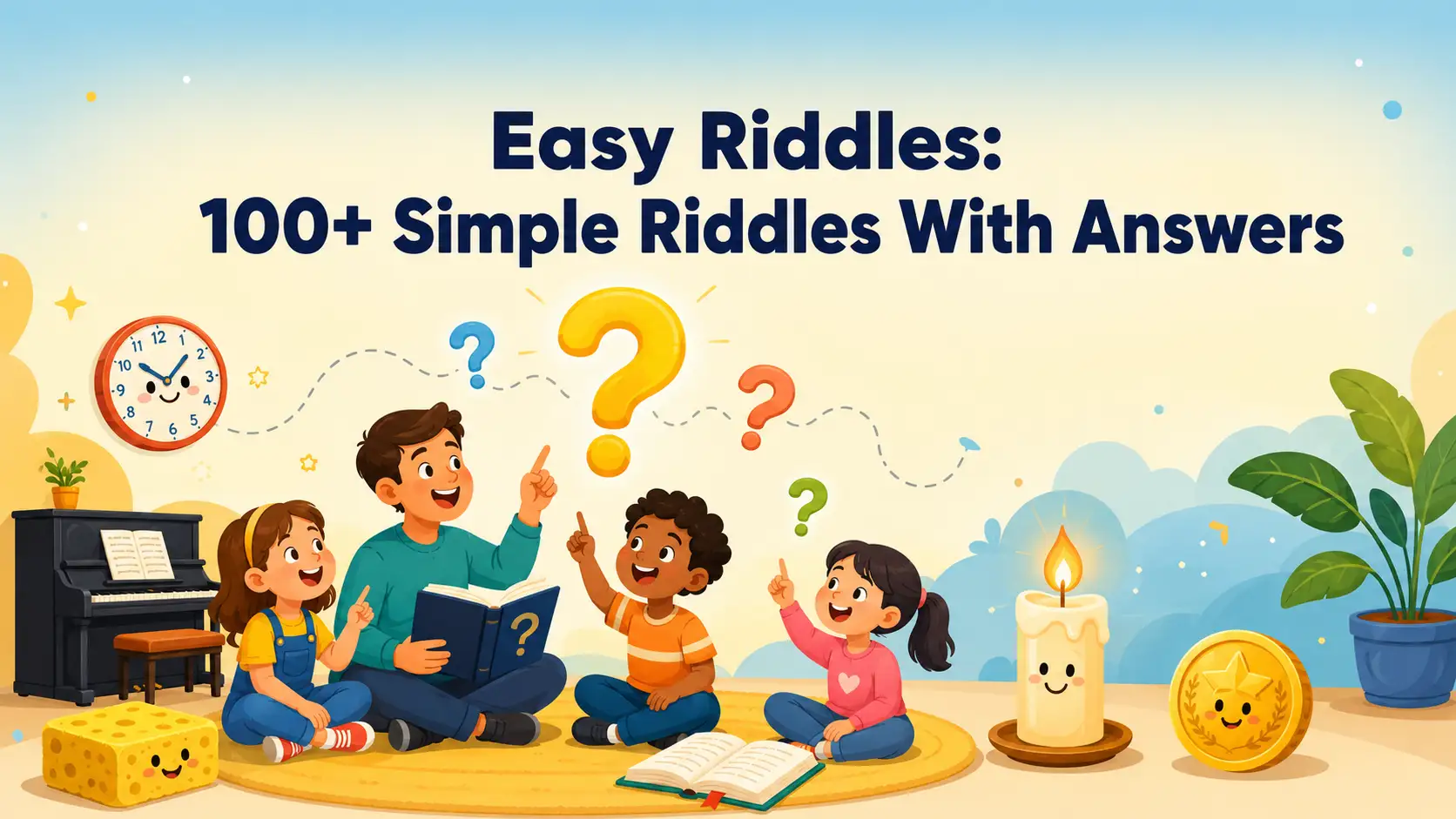
That’s what this guide solves. Below you’ll find over 100 easy riddles with answers, organized by age, style, and difficulty, so you always have one ready. Easy riddles are short, simple puzzles that use everyday objects, playful wordplay, or basic logic to challenge the mind without frustrating it.
They’re a favorite tool among teachers and parents because they build vocabulary, encourage lateral thinking, and make problem-solving feel like play. In this guide, you’ll get riddles for kindergarteners, funny riddles for laughs, simple math riddles, word riddles, and a few for adults who want something light but satisfying.
What Are Easy Riddles? (And Why They’re Good for Your Brain)
An easy riddle is a short question or statement with a clever, often surprising answer that doesn’t require specialized knowledge to solve. Unlike trivia, which tests memory, riddles test reasoning. The best easy riddles use everyday objects, familiar situations, or simple wordplay, so the “aha” moment comes from noticing something obvious in a new way rather than knowing a hidden fact.
Riddles differ from jokes and brain teasers in a subtle but important way. A joke aims for laughter, a brain teaser often requires multiple logical steps, and a riddle sits in between, using a single clever twist to arrive at one clear answer.
Solving riddles regularly offers real cognitive benefits, especially for kids:
- Critical thinking – riddles train the brain to look past the obvious first guess
- Vocabulary growth – wordplay riddles introduce double meanings and new terms
- Patience and persistence – working through a tricky clue builds tolerance for not knowing an answer right away
- Social bonding – riddles are naturally shared out loud, making them a low-pressure way to connect with others
For classrooms, road trips, and family game nights, easy riddles hit a sweet spot: challenging enough to be fun, simple enough that nobody feels left out.
20 Easy Riddles with Answers (Warm-Up Round)
Ready to jump in? These are classic, kid-tested easy riddles perfect for a quick game with no prep needed. Read the question, take a guess, then check the answer below.
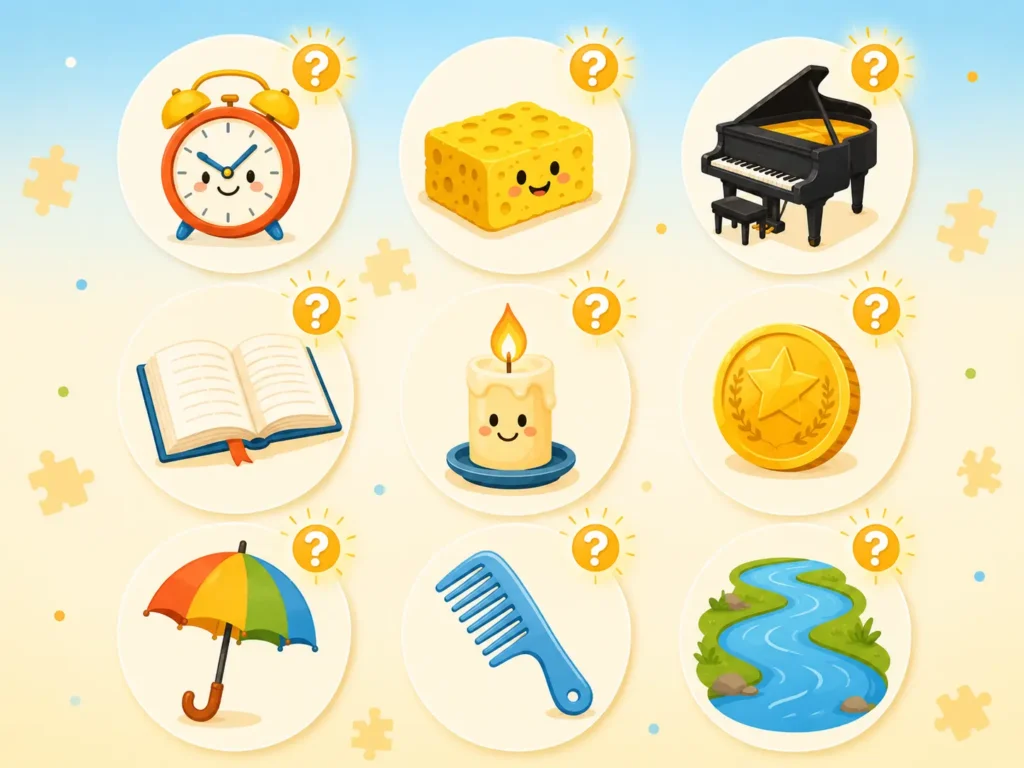
1. What has a face and two hands but no arms or legs? A clock.
2. What gets wetter the more it dries? A towel.
3. What has keys but can’t open a single door? A piano.
4. What can you catch but never throw? A cold.
5. What has a neck but no head? A bottle.
6. What goes up but never comes back down? Your age.
7. What has an eye but cannot see? A needle.
8. What has legs but never walks anywhere? A table.
9. What can travel the world while staying in one corner? A stamp.
10. What is full of holes yet still holds water? A sponge.
11. What has words but never speaks a sound? A book.
12. What has a ring but no finger? A telephone.
13. What kind of coat can only be put on when it’s wet? A coat of paint.
14. What runs all around a yard without ever moving? A fence.
15. What has a bed but never sleeps in it? A river.
16. What has many teeth but cannot bite? A comb.
17. What can you hold without ever touching it? A conversation.
18. What has a head and a tail but no body at all? A coin.
19. What comes down but never goes back up? Rain.
20. What building has the most stories? A library.
Once you’ve worked through this round, you’ll notice a pattern: the best easy riddles trick you into overthinking a simple, everyday object. Keep that in mind as the riddles ahead get slightly more varied.
Easy Riddles for Kindergarten (Ages 4-6)
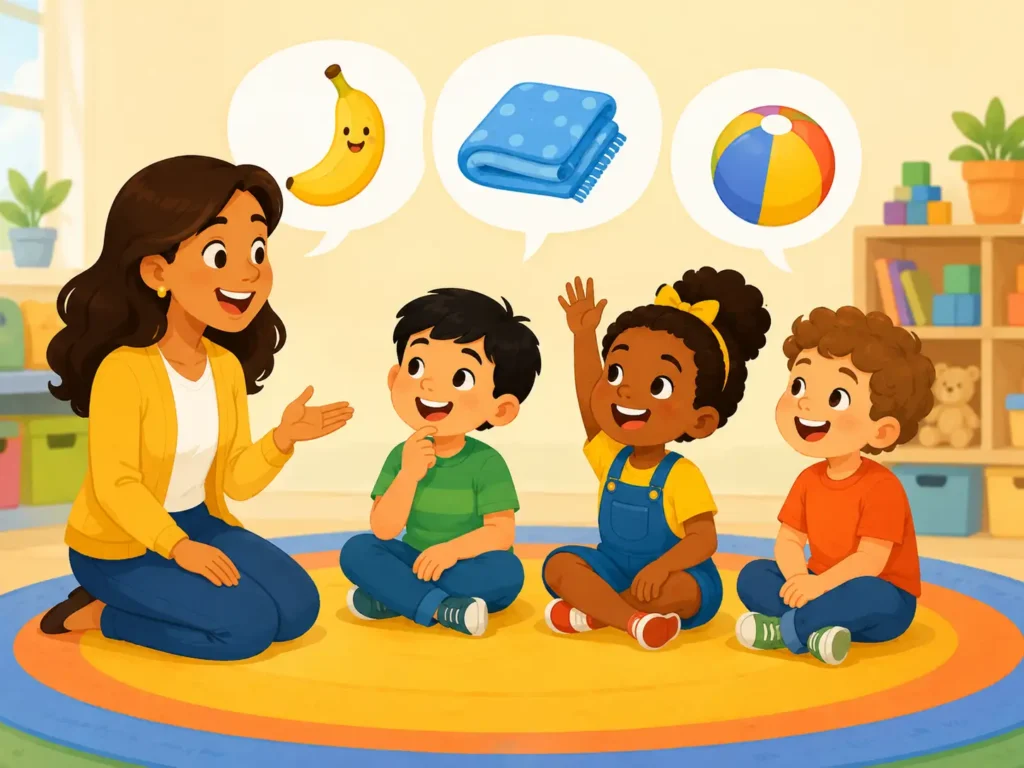
Kindergarten-age kids need riddles with simpler vocabulary, familiar concepts, and answers they can picture right away. At this age, the goal isn’t to stump them, it’s to build confidence and get them excited about guessing out loud.
When choosing riddles for 4 to 6-year-olds, look for ones about animals, colors, shapes, or objects they see every day. Avoid double meanings or wordplay that requires reading fluency, since many kindergarteners are still learning to read.
Try these with your child or class:
1. I am yellow and I go in your lunch box. I have a peel. What am I? A banana.
2. I have four legs but I cannot walk. You sit on me at dinner. What am I? A chair.
3. I am cold, white, and fall from the sky in winter. What am I? Snow.
4. I have a shell and I move very slowly. What am I? A snail.
5. I have two hands but no fingers, and I tell you when to wake up. What am I? A clock.
6. I am round, I bounce, and kids kick me at the park. What am I? A ball.
7. I have a trunk but I am not a tree. What am I? An elephant.
8. I am soft, I keep you warm at night, and you sleep under me. What am I? A blanket.
A good rule of thumb for this age group: if a riddle needs more than one clue to solve, save it for later.
10 Easy Riddles with Answers You Can Use Anywhere
Sometimes you don’t need a huge list, just a handful of reliable riddles you can pull out anywhere: waiting rooms, car rides, lunch breaks, or right before bed. These 10 are short, easy to remember, and work for almost any age.
1. What has a bottom at the top? Your legs.
2. What can you break without ever touching it? A promise.
3. What has one eye but cannot see? A needle.
4. What has a lot of keys but cannot open a single lock? A piano.
5. What kind of band never plays music? A rubber band.
6. What gets bigger the more you take away from it? A hole.
7. What has words but never talks? A book.
8. What has a thumb and four fingers but isn’t a hand? A glove.
9. What can you keep even after you give it away? Your word.
10. What goes up and down but never actually moves? A staircase.
These work well as a memorized “starter pack.” Since none require props or setup, they’re ideal for teachers filling a spare five minutes or parents looking to distract a bored kid without pulling out a phone.
100 Easy Riddles with Answers (The Big List)
This is the full collection, organized by theme so you can jump to whatever mood fits: everyday objects, animals, food, and nature.
Everyday Object Riddles
1. What has a spine but no bones? A book.
2. What has a face but never talks? A clock.
3. What has four wheels and flies? A garbage truck.
4. What has a bark but no bite? A tree.
5. What has hands but cannot clap? A clock.
6. What can fill a room but takes up no space? Light.
7. What has a head and a foot but only one leg? A bed.
8. What is easy to get into but hard to get out of? Trouble.
9. What has an end but no beginning, and a home but no family? A keyboard.
10. What can you see once in a year but never twice in a day? The letter “E.”
11. What is black when it’s clean and white when it’s dirty? A chalkboard.
12. What has 13 hearts but no other organs? A deck of cards.
13. What is cut on a table but never eaten? A deck of cards.
14. What can run but never walks, has a mouth but never talks? A river.
15. What kind of room has no doors or windows? A mushroom.
16. What has a ring but no finger to wear it? A telephone.
17. What starts with a P, ends with an E, and has thousands of letters? A post office.
18. What has a bottom but no top, and holds your legs when you sit? A chair.
19. What can you hold in your left hand but never in your right? Your right elbow.
20. What gets sharper the more you use it? Your brain.
21. What has a heart that doesn’t beat? An artichoke.
22. What can travel around the world while staying in a mailbox? A stamp.
23. What has a bed but never sleeps, and a mouth but never eats? A river.
24. What has legs but doesn’t walk, and a top but no bottom? A table.
25. What is tall when it’s young and short when it’s old? A candle.
Animal Riddles
26. What do you call a bear with no teeth? A gummy bear.
27. What animal is always found at a baseball game? A bat.
28. Why don’t elephants use computers? Because they’re afraid of the mouse.
29. What has a horn but never honks? A rhinoceros.
30. Why are fish so smart? Because they live in schools.
31. What do you call a sleeping bull? A bulldozer.
32. What animal needs to wear a wig? A bald eagle.
33. Why don’t ants ever get sick? Because they have tiny ant-bodies.
34. What do you call a fish with no eyes? A fsh.
35. What kind of tree can you carry in your hand? A palm.
36. Why did the cow go to outer space? To see the mooon.
37. What do you call a pig that knows karate? A pork chop.
38. What has ears but cannot hear a single sound? Corn.
39. Why did the chicken join the school band? Because it had the drumsticks.
40. What do you call a dog that does magic tricks? A labracadabrador.
41. Why are frogs some of the happiest animals? Because they eat whatever bugs them.
42. What do you get when you cross a sheep and a kangaroo? A woolly jumper.
43. What is a cat’s favorite color? Purr-ple.
44. Why did the owl invite all his friends over? Because he didn’t want to be owl by himself.
45. What do you call a cold dog sitting in the snow? A chili dog.
Food Riddles
46. What has many teeth but can never bite into food? A comb.
47. Why did the banana go to see the doctor? Because it wasn’t peeling well.
48. Why did the tomato turn bright red? Because it saw the salad dressing.
49. What kind of cheese isn’t yours to eat? Nacho cheese.
50. What do you call a fake noodle? An impasta.
51. Why did the melon jump into the lake? It wanted to become a watermelon.
52. What did one plate say to the other plate? Lunch is on me.
53. What is orange and sounds exactly like a parrot? A carrot.
54. Why did the student eat his homework? Because his teacher said it was a piece of cake.
55. What has a head, a bed, but never actually eats? A river bank.
56. What kind of coat is always wet? A coat of paint.
57. What has to be broken before you can ever use it? An egg.
58. What can you slice, but it will always stay whole? A loaf of bread.
59. What food is always sad? A blue-berry.
60. What has a shell, a yolk, and cracks easily but isn’t a nut? An egg.
Nature and Weather Riddles
61. What comes down but never climbs back up? Rain.
62. What goes up when the rain starts coming down? An umbrella.
63. What kind of room has no walls at all? A mushroom.
64. What can be as small as a pebble or as big as a mountain, but always melts in heat? Ice.
65. What has a bed but never sleeps in it, and a mouth but never speaks? A river.
66. What gets bigger every time you take a step back from it? A shadow.
67. What falls in winter but never actually gets hurt? Snow.
68. What has branches but no leaves, fruit, or trunk? A bank.
69. I have cities but no houses, forests but no trees, and rivers but no water. What am I? A map.
70. What is always in front of you but can never be seen? The future.
71. What is full of holes but still able to hold water? A sponge.
72. What can you catch, hold, and lose, but never actually touch? Your breath.
73. What kind of tree fits in the palm of your hand? A palm tree.
74. What has an eye but lives in a storm, not a face? A hurricane.
75. What grows taller the older it gets, without ever being alive? A stalactite.
More Everyday Logic Riddles
76. What is so fragile that just saying its name can break it? Silence.
77. What has a golden head and a golden tail but no body in between? A coin.
78. What can you keep even though you always give it away first? Your word.
79. What question can you never truthfully answer “yes” to? Are you asleep yet?
80. What always runs but never actually gets anywhere? A refrigerator.
81. What has one head, one foot, and four legs? A bed.
82. What can you break just by naming it out loud? Silence.
83. What belongs to you, but is used by everyone else more than by you? Your name.
84. What can fill an entire room without taking up any space at all? Light.
85. What has many rings but no fingers? A telephone.
86. What kind of band never plays a single song? A rubber band.
87. What travels all over the world but always stays in one corner? A postage stamp.
88. What can be given, but can never be sold? Advice.
89. What has to be returned before it’s ever been fully used? A boomerang.
90. What has 100 legs but cannot walk? A centipede.
91. What always stays in a corner but travels the whole world? A stamp.
92. What can you catch without ever using your hands? A cold.
93. What has a lock but no key needed to open it? Your hair (a lock of hair).
94. What is easy to lift but impossible to throw very far? A feather.
95. What has four legs in the morning, two at noon, and three in the evening? A person (crawling as a baby, walking as an adult, using a cane when old).
96. What kind of house weighs the least? A lighthouse.
97. What can you break but never actually pick up? A record (as in “breaking a record”).
98. What has a neck but never a head, and arms but never hands? A shirt.
99. What is always coming but never actually arrives? Tomorrow.
100. What starts with an E, ends with an E, but only ever contains one letter? An envelope.
Funny Riddles for a Good Laugh
Not every riddle needs to be a brain workout. Sometimes the best ones are just plain funny, more like a joke wearing a riddle’s costume. These are great for lightening the mood in a classroom or getting a genuine laugh at the dinner table.
1. Why did the scarecrow win an award? Because he was outstanding in his field.
2. Why did the golfer bring two pairs of pants? In case he got a hole in one.
3. What did one wall say to the other wall? I’ll meet you at the corner.
4. Why don’t scientists trust atoms? Because they make up everything.
5. Why don’t eggs ever tell jokes? Because they might crack up.
6. What is brown, sticky, and found in the forest? A stick.
7. Why was the soccer stadium so cool? Because it had a ton of fans.
8. What did the ocean say to the other ocean? Nothing, they just waved.
9. Why was the math book always sad? Because it had too many problems.
10. Why did the bicycle fall over in the driveway? Because it was two-tired.
Funny riddles work especially well as icebreakers because there’s no pressure to think hard. The punchline does the work, so even kids who feel shy about guessing can enjoy the payoff.
Easy Math Riddles (Simple Number Puzzles)
Math riddles sneak number sense and logic practice into something that feels like a game rather than homework. These are simple enough for elementary-age kids but still require a moment of real thinking.
1. What number, when you take away a letter, turns from odd to even? Seven (remove the “s” to get “even”).
2. If two’s company and three’s a crowd, what are four and five? Nine.
3. A farmer has 17 sheep, and all but 9 run away. How many are left? 9.
4. What three numbers give the same result whether added or multiplied? 1, 2, and 3.
5. If you’re running a race and pass the person in second place, what place are you in now? Second place.
6. Which is heavier: a ton of bricks or a ton of feathers? Neither, they both weigh exactly the same.
7. What has 100 legs, walks on none, but is still counted as one number puzzle? It depends on interpretation, a common trick answer is “a pair of 50 shoes.”
Math riddles are especially useful for teachers because they double as a quiet review of arithmetic, comparisons, and logical reasoning, all without a worksheet in sight.
Easy Word Riddles (Letters, Language, and Wordplay)
Word riddles play with spelling, letters, and the quirks of the English language. They’re a fun way to sneak in vocabulary practice, especially for kids who are just becoming confident readers.
1. What five-letter word becomes shorter when you add two letters to it? Short.
2. What word starts with the letter “e” but only ever contains one letter? Envelope.
3. What four-letter word can be read the same forward, backward, and even upside down? NOON.
4. What word looks the same even if you take away four of its five letters? Queue (it still sounds like “Q”).
5. What begins with a “T,” ends with a “T,” and has “T” inside it too? A teapot.
6. What word in English keeps getting shorter no matter how many letters you add? Short.
7. What can you find in the middle of every single day? The letter “A.”
Word riddles are a natural bridge to reading comprehension, since kids have to actually picture the spelling of the word to solve them, not just imagine an object.
Easy Riddles for Adults (Simple but Satisfying)
Adults don’t always want a brain-melting puzzle, sometimes a quick, satisfying riddle is exactly the right amount of challenge for a coffee break or a game night. These lean slightly more clever than the kid-focused riddles above, without tipping into “hard.”
1. What can you hold without ever touching it, and give without ever losing it? A promise.
2. The more you take, the more you leave behind. What are they? Footsteps.
3. I shave every single day, but my beard never changes. What am I? A barber.
4. What question can you never honestly answer “yes” to? Are you asleep yet?
5. What has a golden face, a golden tail, but hides an entire head in between? A coin.
6. The person who makes it has no need for it. The person who buys it never uses it. What is it? A coffin.
7. What can you give to someone else and still keep for yourself? Your word.
These riddles work well for happy hour icebreakers, team meetings, or simply testing a partner’s patience on a long drive.
From Easy to Hard: When You’re Ready for a Bigger Challenge
Once these easy riddles start feeling too simple, it’s a good sign you’re ready to level up. Hard riddles for adults typically require holding two or three clues in your head at once, rather than spotting one obvious twist.
Here’s a small taste of what that looks like:
1. I turn once, and what is out will not get in. I turn again, and what is in will not get out. What am I? A key.
2. I have lakes with no water, mountains with no stone, and cities with no buildings. What am I? A map.
3. The more of this there is, the less you can see. What is it? Darkness.
If these three felt noticeably tougher than the earlier sections, that’s the natural next step: search out a dedicated hard riddles collection once you’ve worked through the easy ones here.
The Best Riddles and Answers, Ranked by Popularity
If you only have time for a handful, these are consistently the riddles people share, repeat, and remember most, pulled from every category above.
1. What has a face and two hands but no arms or legs? A clock.
2. What is full of holes but still holds water? A sponge.
3. What has to be broken before you can use it? An egg.
4. What goes up but never comes back down? Your age.
5. What can you catch but never throw? A cold.
6. What is always in front of you but can never be seen? The future.
7. What has one eye but cannot see? A needle.
8. I turn once, and what is out will not get in. What am I? A key.
9. What can fill a room but takes up no space? Light.
10. What is so fragile that saying its name can break it? Silence.
These have stayed popular for a reason: each one uses an object everyone recognizes, and the twist is genuinely satisfying to figure out, not frustrating.
Tips for Using Riddles with Kids (Teachers and Parents)
Riddles work best when they’re introduced the right way. A few practical habits make a big difference in how much kids enjoy them:
- Give thinking time. Resist the urge to jump in with the answer after just a few seconds of silence. Kids often need 20-30 seconds to work through a riddle.
- Offer hints, not answers. If a child is stuck, nudge them toward the answer (“Think about what you see every day in the kitchen”) instead of revealing it outright.
- Let kids take turns asking. Flipping the roles builds confidence and encourages kids to really understand the riddle instead of just memorizing answers.
- Match difficulty to the moment. Save trickier riddles for older kids or calmer settings, and stick to simple ones during chaotic moments like car rides.
- Celebrate wrong guesses too. A clever wrong answer often shows just as much reasoning as the right one, so acknowledge the thinking, not just the result.
Used consistently, riddles become a reliable classroom warm-up, a road trip staple, or a bedtime ritual kids look forward to.
FAQ
What is an easy riddle? An easy riddle is a short question with a clever answer that uses everyday objects or simple wordplay, requiring one logical twist rather than multiple steps to solve.
What are 5 easy riddles? Common examples include: What has a face but no arms? (a clock), what gets wetter as it dries? (a towel), what has an eye but can’t see? (a needle), what runs but never walks? (water), and what has keys but no locks? (a piano).
What is the easiest riddle in the world? Riddles like “What has to be broken before you can use it?” (an egg) are often considered among the easiest, since the answer requires only one small mental shift to see.
Are riddles good for kids’ brain development? Yes. Riddles build critical thinking, vocabulary, and problem-solving skills while making reasoning feel like play rather than schoolwork, which helps kids stay engaged longer.
What age are easy riddles appropriate for? Most easy riddles work well for kids ages 5 and up, while simplified versions with familiar objects and animals suit kindergarteners as young as 4.
What’s the difference between a riddle and a brain teaser? A riddle usually has one clever twist and a single clear answer, while a brain teaser often requires multiple logical steps or calculations to solve.
How do you explain a riddle to a young child? Break it into one clue at a time, ask what they picture in their mind, and gently guide them toward connecting the clues instead of giving the answer immediately.
What are some easy riddles with answers for a classroom icebreaker? Short, universally familiar riddles work best, such as “What has hands but can’t clap?” (a clock) or “What can you catch but never throw?” (a cold), since nearly every student can picture the answer.
Conclusion
Easy riddles are a simple, low-effort way to spark curiosity, build vocabulary, and bring people together, whether you’re filling five minutes in a classroom or keeping kids entertained on a long drive. With over 100 riddles across kid-friendly, funny, math, word, and adult categories, you now have a ready-made collection for nearly any occasion.
The best way to use them is simply to start: pick a few from this guide, share them out loud, and let the guessing begin. As riddles start feeling too easy, that’s your cue to move on to trickier ones. Bookmark this page so you always have a fresh batch of easy riddles with answers on hand, whenever the moment calls for one.